
Table of Contents
- What Makes Early Readers Special?
- Crafting Effective Early Reader Stories
- Key Takeaways
- Next Step
- FAQs
- More Common Questions & Answers
- Is AI-generated content appropriate for teaching children to read?
- How do I ensure the reading level is appropriate for my child?
- Will illustrations created by AI lack the warmth and appeal of human-created art?
- How do I maintain character consistency across a book when using AI?
- What makes an effective early reader story structure?
- How can I incorporate phonics patterns into AI-generated stories?
- What are the costs associated with creating AI early readers compared to purchasing them?
- How can I ensure diverse representation in AI-generated early readers?
Early reader children's books serve as crucial stepping stones in a child's literacy journey, bridging the gap between being read to and reading independently. As emerging readers take their first steps into the world of self-guided reading, these carefully crafted books provide the perfect balance of challenge and achievement.
What Makes Early Readers Special?
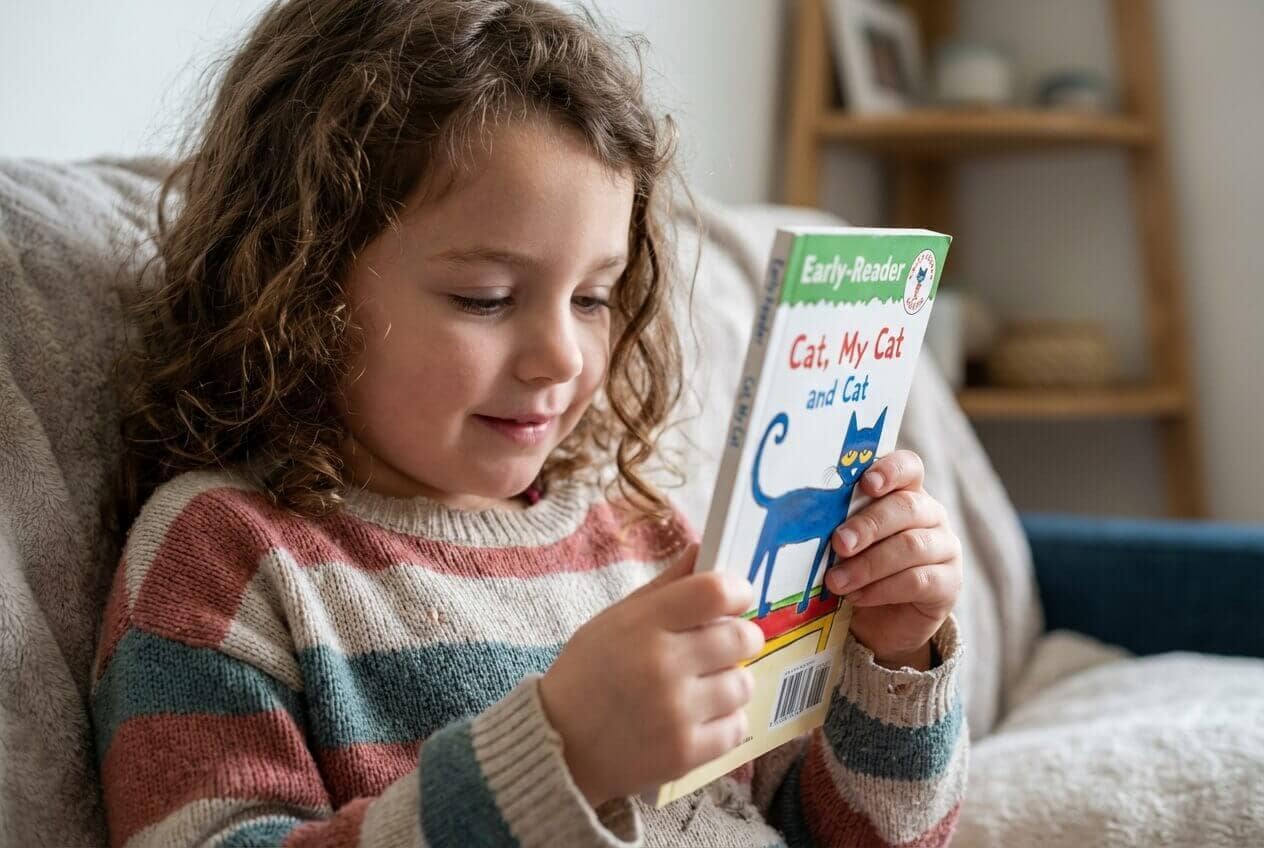
Early reader children's books are specifically designed for children aged 5-8 (primarily kindergarten and first grade) who are beginning to read on their own. These books differ from standard picture books in several key ways:
Controlled vocabulary: They use simple, familiar words with consistent phonetic patterns.
Short, straightforward sentences: Often following basic subject-verb-object structure.
Supportive illustrations: Pictures that directly enhance understanding of the text.
Manageable length: Typically 24-32 pages to be completed in one sitting.
Age-appropriate themes: Stories about relatable problems and experiences.
Crafting Effective Early Reader Stories
Story Structure and Content
The most successful early reader children's books incorporate:
Relatable characters: Children connect with protagonists similar to themselves or charming animal characters like Milo the Cat.
Simple narrative arcs: Clear beginning, middle, and end with gentle conflicts.
Repetitive patterns: Predictable sentence structures that build reading confidence.
Educational objectives: Subtly embedded learning goals around literacy or social-emotional skills.
Positive resolutions: Encouraging outcomes that reward the reader's effort.
Using AI to Generate Early Reader Content
AI tools can streamline the early reader children's book creation process through carefully crafted prompts. An effective prompt should specify:
Reading level: "Write an early reader book for kindergarten level readers."
Tone: "Use a gentle, encouraging tone."
Character details: Description of appearance, personality, and traits.
Setting: Simple but descriptive location information.
Theme: Clear message or learning objective.
Structure requirements: Word count, sentence length, and page count parameters.
Creating Consistent Illustrations
One of the biggest challenges in creating early readers is maintaining visual consistency throughout the book. Here are three effective approaches:
1. Character Reference Sheets
Creating a detailed character reference sheet before illustrating provides a blueprint for consistent representation. Include:
Physical attributes (hair color, clothing, distinctive features)
Personality traits that influence expression and posture
Multiple angles (front, side, back views)
Bonus: Use our Character Turnarounds app in the EMAI App Suite!
2. Using AI Reference Images
For AI-generated illustrations:
Upload a reference image to guide character appearance.
Include detailed character descriptions in each illustration prompt.
Use consistent style descriptions for every illustration.
3. Style Consistency Techniques
Maintain the same artistic style throughout (like "3D illustration resembling a miniature toy diorama" or "animated TV style").
Use color palette references in your prompts.
Specify square aspect ratio for consistent formatting.
Bonus Tip
Use one of our pre-programmed Children's Book Illustrator apps in our exclusive EMAI App Suite to maintain character and style consistency!
Claim My Free Trial Publishing Your Early Reader
Once your story and illustrations are complete:
Layout options: Use tools like PowerPoint, Canva, or Adobe InDesign.
Technical specifications: Follow print-on-demand requirements (300 DPI resolution, bleed margins).
Professional finishing touches: Include copyright page, ISBN barcode, and age-appropriate labeling.
Marketing materials: Create book descriptions, social media content, and promotional images.
Key Takeaways
Creating effective early reader children's books requires understanding the unique needs of emerging readers. By utilizing AI tools with proper guidance, you can create engaging, consistent stories that build reading confidence while maintaining visual appeal. The combination of simple vocabulary, relatable characters, and supportive illustrations creates the perfect environment for children to develop crucial literacy skills.
Whether creating a standalone title or planning a character-based series, early readers offer a wonderful opportunity to support young children as they embark on their reading journey.
Next Step
Enroll in our exclusive course in our series The Publishing Expert: Create Early Readers & Chapter Books for detailed step-by-step guidance on how to create and sell Early Readers and Chapter Books with AI!

FAQs
Do I need experience to use AI to create Children's Early Readers?
No! Our training programs and free resources give you all the steps you need to create beautiful, well-written, engaging Children's Early Reader books, even with no experience.
Doesn't Amazon ban AI-written and illustrated books?
Nope! Amazon doesn’t ban AI books. They even have their own AI tools for audiobooks. They just ask if you used AI, but it’s only for their own info. It’s not shared with the public.
Do you have a course for this?
Yes we do! Check out our exclusive course in The Publishing Expert series, Create Early Readers & Chapter Books.
Do you offer live training?
You bet we do! In fact, our trainings start with live sessions. Why? Because we know real breakthroughs happen in real time… when you can ask questions, get clarity, and experience those “aha!” moments alongside others on the same journey. Every live training is recorded and turned into on-demand lessons, so you’ll never miss a thing even if life gets in the way.
Are replays available for live trainings?
Absolutely. Every single live session comes with full replay access. That means you get to review, revisit, and implement at your own pace, on your own schedule. Missed the live call? No worries! You’ll have all the material, all the insights, ready for you, whenever you need them.
Do you train on AI?
Yes, and we’ve been doing it long before it became a buzzword. Our head instructor, Tony Laidig, has been pioneering creative AI education since 2018, before most “experts” even knew what a prompt was! Tony is a trusted resource for major brands, a master of practical AI, and a best-kept secret for those who want real results. If you want to get ahead of the curve (and stay there), you’re in the right place.
Will you help me personally?
We don’t just hand you content and wish you luck. Our programs are built to give you real support every step of the way, whether you want quick wins or deep transformation.
Need tactical tools, templates, and monthly LIVE Q&A? Our “AI Profit Play!” membership gives you all of that for less than your favorite coffee.
Want hands-on tools, guided resources, AI certification, and a creative community? Our EMAI App Suite and Creator’s Club deliver full systems and ongoing learning.
Ready for serious momentum, strategy, and feedback? Our EMAI Business FlowMaker Coaching gives you one-on-one guidance from certified pros who care about your results.
No matter where you’re at, we’ve got a path and real people to help you win.
Do you have a Community?
We do, and it’s not your average Facebook group. “The Creatives’ Hangout” is where authors, artists, product creators, and visionaries gather to connect, collaborate, and lift each other up. Imagine a place where everyone is moving forward, sharing wins, solving problems, and celebrating creativity. That’s the power of community, and you’re invited!
More Common Questions & Answers
Is AI-generated content appropriate for teaching children to read?
AI-generated content can be highly appropriate when properly guided by literacy principles. The key is ensuring the AI follows established educational frameworks for early literacy, including controlled vocabulary, appropriate sentence structures, and developmental progression. With proper oversight, AI can actually help customize reading material to a specific child's interests and reading level, potentially increasing engagement.
How do I ensure the reading level is appropriate for my child?
Look for indicators like word count per page (5-10 words for beginning readers), sentence structure complexity, and vocabulary choices. Most early reader children's books follow established leveling systems like Guided Reading Levels, Lexile measures, or DRA levels. You can test appropriateness by having your child read a sample page - they should be able to read about 90-95% of the words independently for the level to be right.
Will illustrations created by AI lack the warmth and appeal of human-created art?
Modern AI illustration tools like those in the EMAI App Suite can create warm, appealing images when guided properly. The key is providing clear style references and character descriptions, and maintaining consistency throughout the book. Many AI illustrations now rival traditionally created art in terms of appeal to children. That said, the human touch comes in curating, selecting, and directing the AI to create art that resonates with young readers.
How do I maintain character consistency across a book when using AI?
Create a detailed character reference sheet (use the EMAI Character Turnarounds app) before starting, including specific physical attributes, clothing, and expressions. Use this reference consistently in your prompts, along with explicit instructions about maintaining the same appearance. Consider uploading reference images to guide the AI, and specify the exact same style description in each illustration prompt. And review illustrations sequentially to catch any inconsistencies.
What makes an effective early reader story structure?
Effective early reader children's books follow a simple but complete narrative arc with a clear beginning, middle, and end. They typically include: a relatable main character, a small problem or goal appropriate to the age group, 2-3 simple attempts to solve the problem, and a satisfaction resolution. Repetitive phrases or sentence patterns help build reading confidence, and text should be carefully aligned with illustrations to provide context clues.
How can I incorporate phonics patterns into AI-generated stories?
Specify the exact phonics patterns you want to target in your AI prompts. For example, "Create a story using primarily CVC (consonant-vowel-consonant) words and the short 'a' sound." You can also request word families (like -at words: cat, hat, bat) or specific sight words appropriate to the reading level. After generating the text, review it carefully to ensure phonetic consistency and make manual adjustments as needed.
What are the costs associated with creating AI early readers compared to purchasing them?
Creating AI early reader children's books typically involves subscription costs to AI text and image generation tools (ranging from $10-30 monthly), possible layout software costs, and time investment. Self-publishing through print-on-demand services might add $2-5 per physical copy. Commercially published early readers typically cost $4-8 each, with classroom sets or series becoming quite expensive. The cost-effectiveness increases if you create multiple books or customize stories to specific children's interests.
How can I ensure diverse representation in AI-generated early readers?
Explicitly specify diversity requirements in your AI prompts, including detailed descriptions of characters from various backgrounds, cultures, abilities, and family structures. Review generated content carefully to avoid stereotypical representations, and be specific about cultural elements you wish to include. The advantage of AI-created content is the ability to customize representation beyond what's commonly available in commercial offerings.


![[12 Days of Giftmas] 🎁 Day 2: Mystical Journeys Magazine](https://dropinblog.net/img/3inz1i6s/700/day-2-giftmas-blog)